How to Pass LARE Planning and Design (P&D): A Study Plan
Planning and Design (P&D) — still called “Section 2” by many candidates — is where the L.A.R.E. tests site planning, spatial organization, and design principles for sustainable, functional landscapes. If Inventory, Analysis, and Project Management (IAPM) asks whether you gathered the right information, P&D asks whether you can turn that information into alternatives that actually fit the site.
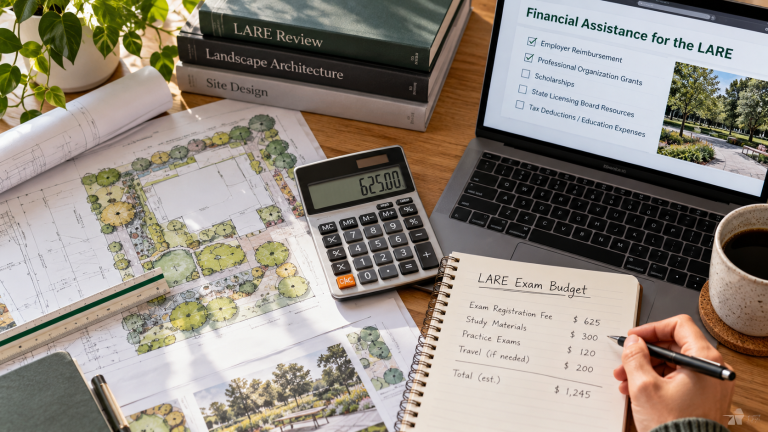
CLARB lists the fee at $545 per section. Confirm the current amount on CLARB’s fees page. For exam facts, FAQ, and the waitlist on one page, use our Planning and Design hub.
Start With What CLARB Says Is on the Exam
Download the current CLARB Candidate Handbook (October 2026 edition at the time of writing) before you organize your notes. For P&D it lists:
- 85 scored questions plus 10 unscored pretest questions
- 3 hours to complete the exam, inside a 3.5-hour appointment
- Four question types: multiple choice, multiple response, drag-and-place, and hot spot
- Fee: $545 (CLARB)
The handbook also lists P&D subdomains and weights. In plain English, expect stewardship and design principles, master planning, schematic design, and design development. Use the handbook for official names and percentages. Spring 2026 pass rate for P&D was 64% — confirm newer administrations on CLARB’s pass rates page.
Weeks 1–2: Learn the Handbook’s Design Language
Professional experience helps, but the L.A.R.E. tests a shared body of knowledge. A residential designer and a campus planner can both pass — if they study how the outline defines the work, not only how their own office draws.
- Read the P&D subdomain descriptions end to end and note vocabulary that is fuzzy for you (master plan vs. schematic vs. design development relationships).
- Pick one primary recommended reference you will finish; skim others only for weak topics.
- Gather a small set of public plans (parks, streetscapes, campuses) to use as practice “sites” for alternative comparison.
Weeks 3–5: Program, Constraints, and Fit
Many P&D items reward candidates who can tell what fits before they fall in love with a layout.
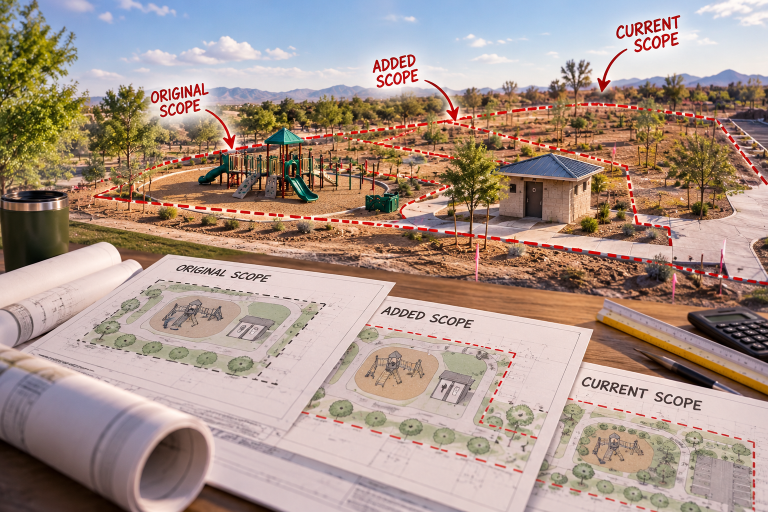
- Do the math privately. List program elements, assign realistic footprints (including circulation and buffers), subtract constraints (slopes, floodplain, easements, setbacks), and compare to usable area and budget.
- Make footprints visible. Scaled bubble diagrams beat vague optimism. Parking is often the land hog — check it early.
- Practice trade-offs. Prioritize, phase, combine uses, or rethink parking — and be ready to explain why.
John’s published guidance on this conversation is in How to Tell a Client Their Wish List Won’t Fit on the Site, drawn from a colleague’s megachurch campus project where parking alone took a huge share of the land. The method — math first, visible footprints, lead with the client’s goals, offer paths — is exactly the judgment P&D is looking for.
Weeks 6–7: Alternatives, Stewardship, and Refinement
Move from “does it fit?” to “which alternative best meets the stated goals?”
- Compare schematics against criteria. Accessibility, circulation, safety, stewardship, and code relationships — not only aesthetics.
- Master-plan thinking. Practice organizing larger programs into coherent frameworks without stranding later phases.
- Design development discipline. When the preferred direction is chosen, what gets more specific (materials, relationships, detailing intent) without inventing facts the prompt did not give you?
Stay close to IAPM notes while you do this. Inventory and analysis feed every good planning decision, which is why many candidates study these two sections as a pair — see section order advice.
Weeks 8–10: Pacing and Timed Practice
Advanced and graphic-style items can steal the clock. A pacing tactic many candidates report (test it in your own practice exams; it is not CLARB policy): clear written multiple-choice and multiple-response items first, flag hard ones, then return to drag-and-place and hot-spot items. Every question is worth one point.
- Run timed mixed sets and at least one full-length simulation.
- Keep an error log: program math, accessibility, circulation, stewardship, misread prompts.
- Review handbook item-type examples so the interface is familiar.
For weekly hours, see How Many Hours a Week Should You Study for the LARE? Fee context: LARE Exam Cost in 2026.
From the Field
When a client’s wish list will not fit, the hard meeting is not design criticism — it is shared disappointment. John’s advice, grounded in that published campus story: do the area and budget math before the meeting; show scaled footprints so the conflict is visible; restate the client’s mission goals; never rank someone’s favorite amenity as “bad”; offer prioritization, phasing, combined uses, or parking strategies; and document the decisions afterward so the committee does not recreate the same fight next month.
On the exam, that translates to: read the constraints in the stem, discard alternatives that ignore land area or accessibility, and choose the option that best protects health, safety, and welfare while meeting the stated program priorities.
Sample Practice Question
Original LandCertPrep item for practice only. Not a CLARB exam question and not copied from the real exam.
A schematic package for a civic plaza shows an event lawn, a playground, a café terrace, and on-site parking for peak weekend attendance. The landscape architect’s area takeoff shows the combined program exceeds usable site area after setbacks and a required utility easement. The client insists everything must be in phase one. What is the landscape architect’s best next step?
- A. Reduce parking below code requirements without telling the client, to free land for the amenities
- B. Present the area takeoff at scale, explain the shortfall, and facilitate a choice among prioritization, phasing, or combined uses while keeping code-required parking on the table
- C. Promise that construction detailing will create enough land
- D. Remove the playground unilaterally because it is the smallest amenity
Answer: B. Make the constraint visible and help the client decide. Cutting code parking in secret (A) and promising free land from detailing (C) are unsafe; deleting a favorite without process (D) breaks trust without solving the math.
A Few Habits That Make the Difference
- Fit before flourish. Program math and constraints first.
- Score alternatives against the prompt. The “prettiest” sketch is wrong if it fails accessibility or circulation criteria in the stem.
- Watch the clock on graphics. Practice a pacing plan before test day.
- Keep IAPM close. Bad inventory makes bad plans.
How P&D Connects to the Rest of the Exam
Planning and Design does not live in a vacuum. Site data and stakeholder outcomes from IAPM become the constraints you design against. Grading and drainage decisions that show up in GDSM affect whether a schematic is buildable. Construction documentation in CDA is how a preferred plan becomes enforceable in the field. You do not need to study all four at once, but when a P&D practice item mentions floodplain, accessible routes, or bid-phase clarity, recognize which neighboring section owns the deep dive.
If you fail a section, you keep credit for the ones you pass and retake only what you missed — details in Failed a LARE Section? Use the final week before your window for review, not new material: The Final Week Before the LARE.
Get Ready With LandCertPrep
LandCertPrep is building a Planning and Design (P&D) study guide and original practice questions mapped to CLARB’s current content outline. Visit our Planning and Design (P&D) hub for exam facts, FAQ, and related reading, then join the waitlist below for free sample questions and the LARE Study Plan and Readiness Checklist.
Also see the other section hubs: IAPM · P&D · CDA · GDSM · Landscape Architecture overview.
LandCertPrep is an independent publisher (a FranciscanLandscape LLC company) and is not affiliated with, endorsed by, or sponsored by CLARB, LATC, or any licensing board. Exam facts are summarized from official sources as of October 2026; always confirm current details with the exam body.

One Comment